Research story
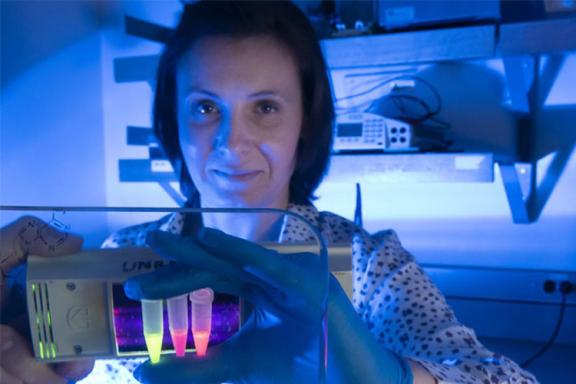
When Dr. Peter Unrau of Simon Fraser University (SFU) decided to shift his academic focus from theoretical physics to molecular biology in 1996, it became abundantly clear to him that ribonucleic acid (RNA) would be an increasingly important molecule in his field. He has since witnessed a dramatic spike in RNA research that only continues to grow. Along with deoxyribonucleic acid (DNA) and proteins, this tiny macromolecule is believed to be responsible for creating the living world we know today.
The power of RNA has long been the focal point for

The COVID-19 pandemic prompted a shift in priorities for Dr Unrau, who recognized an opportunity to recalibrate his RNA Mango aptamers. The technology, which was initially being developed for the single molecules of RNA within cells and the detection of pathogens in tissue culture, would now be used to detect illnesses such as COVID-19 through an isothermal RNA detection kit. The premise is simple: a saliva sample is collected in a test tube, and then a lateral flow strip with a RNA Mango reporter is inserted. It is at this point of contact where the science behind RNA Mango amplifies the presence of any viral RNA through its fluorescent properties. If the individual is infected, a test line will light up indicating the presence of viral RNA.
Dr. Unrau notes most of the challenges his team encountered throughout this process have been outside of his laboratory. In order to facilitate the isothermal RNA detection kit project, he had to assemble a working group that included clinicians and virologists – all while working to secure a high-level containment facility to culture the virus safely. Despite the University being nearly shut down due to the COVID-19 pandemic, Dr. Unrau remains encouraged by recent conversations he has had regarding the potential commercialization of the detection kit. “I’m always an optimist,” Dr. Unrau reflects. “We’re negotiating with some large companies at the moment who may take on the task of doing it. It’s really hard to know how helpful it’ll be for the COVID pandemic we’re encountering right now; however, what is clear is that we do need much better technologies to do testing on the scale of an entire country.”
When asked about the future of the detection kits, Dr. Unrau highlights the versatility of his product. “Because it’s a nucleic acid-based test, it can be reprogrammed for whatever you want,” notes Dr. Unrau. “Most of the hard work is behind us on the scientific side, the remaining challenges are ‘how do you package the technology?’ and ‘how do you repurpose it rapidly for different diseases?’”
Dr. Unrau acknowledges the pivotal role that NSERC has played in his research career. “It’s very rare to find such funding opportunities that are available. It’s nice that there’s a funding agency that believes that you can spend the money as you see fit, based on your research. We wouldn’t have these Mango aptamers if it hadn’t been for an NSERC Discovery Grant.” The work being done by Dr. Unrau and his lab is funded in part by the
Looking to the future of RNA research, Dr. Unrau is excited about the new crop of scientists entering the field and the discoveries yet to be made. “RNA is a really cool molecule, and it can do a lot. We keep studying and finding more and more clever things that nature does out of RNA that we never appreciated.” He cites the CRISPR system, the most recent Nobel Prize-winning genome editing technique, as a game-changing development in the field of RNA. It is developments such as this that will keep the study of RNA at the forefront of molecular biology for years to come.